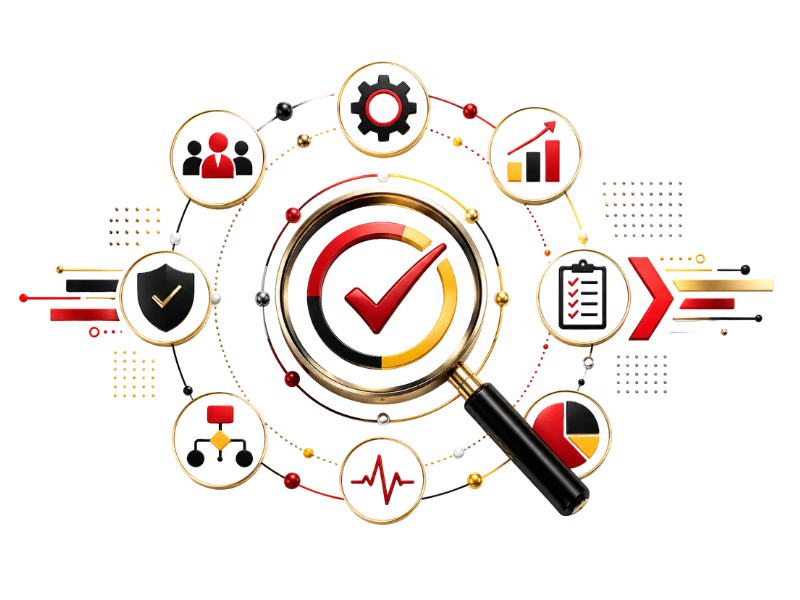
A busy business isn’t always a healthy one. The InsightSolve Operational Health Check looks at the six areas that determine whether your business can grow or is quietly working against itself.
Most business owners feel it before they can explain it. Things are busy, but something isn’t quite right. Deadlines keep slipping. The same problems keep coming back. You’re working harder, but it feels like you’re getting less done. The issue usually isn’t your effort. Its the foundation underneath it.
Every business runs on six things: its People, its Processes, its Systems, its Capacity, its Clarity, and its Culture. When all six are working well together, a business runs smoothly and grows with confidence. When even one of them is broken, everything else has to work harder to make up for it.
That’s what an operational health check is all about. It’s a structured way to look honestly at each of these six areas and find out what’s working, what’s struggling, and what to fix first. Think of it as a full physical exam for your business, not just a quick check of the obvious symptoms, but a real look under the hood.
This article walks you through all six areas and explains what a healthy versus unhealthy version of each looks like. By the end, you’ll have a clear picture of what the InsightSolve Operational Health Check measures and why taking it might be the most useful 10 minutes you invest in your business this year.
The Six Areas That Determine Your Operational Health
Let’s look at each one. As you read, think honestly about how your business shows up in each area. The patterns will start to become clear.
People – Dimension 1 of 6
Your team is the engine of your business. But having great people isn’t enough on its own. The People dimension of the health check looks at whether you have the right people in the right roles, whether critical knowledge is safely spread across your team, and whether your staff have what they need to do their best work.
One of the biggest risks many businesses carry is key person dependency. This is when too much essential knowledge lives inside one or two people’s heads. If they get sick, leave, or move on, a big part of how your business operates walks out the door with them. It’s a risk most business owners know exists but few have taken steps to fix.
A healthy People dimension means your team doesn’t collapse when someone is out. It means roles are clear, skills are matched to the work, and the knowledge that keeps your business running is captured and shared – not locked in any single person.
People Questions the Health Check Explores
If your top performer left tomorrow, what would break and how fast?
Are roles clearly defined or do people constantly step into each other’s work?
Does your team have the skills your business needs right now and for where its heading?
Is critical operational knowledge documented or does it live in someone’s memory?
Process – Dimension 2 of 6
Process is how work actually gets done in your business. Not how you think it gets done. Not how a procedure document says it should work. How it actually happens, day to day.
Most businesses have a version of what’s called process debt – the accumulated result of workarounds, shortcuts, and undocumented habits that have built up over time. These things often start as quick fixes. Over time, they become the way things are done. Nobody questions them. And nobody has written them down.
A healthy Process dimension means your core workflows are documented, consistent, and designed to produce good outcomes – not just outcomes that depend on the specific person doing the work. It means rework is low, quality is predictable, and new team members can get up to speed quickly because there’s a clear standard to follow.
When processes are broken or missing, you see it in the day-to-day: the same mistakes repeating, time lost fixing things that shouldn’t have gone wrong in the first place, and a team that has to rely on tribal knowledge to get through the week.
Process Questions the Health Check Explores
Are your core business processes documented at a level a new hire could follow?
How much time does your team spend on rework or fixing avoidable errors?
Do different team members handle the same task in different ways, with different results?
When something goes wrong, is there a clear process for catching and fixing it?
67% of digital transformation and automation projects fail due to organizational resistance – not technology. When processes and people aren’t ready, technology alone cannot fix it.
McKinsey & Company, State of AI Report 2023
Systems – Dimensions 3 of 6
Systems are the tools and technology your business uses every day – software platforms, databases, communication tools, reporting dashboards, and everything in between. The Systems dimension of the health check looks at whether your technology is actually helping your business or quietly creating friction.
Here’s a sign that your systems health is poor: your team runs parallel spreadsheets alongside your software. When people create their own workarounds to compensate for a system they don’t trust or can’t use effectively, it’s a signal that either the system isn’t the right fit, it hasn’t been set up correctly, or the data inside it can’t be trusted.
A healthy Systems dimension means your technology works for your team, not the other way around. Data is accurate. Different tools talk to each other. Your team can find the information they need without digging through inboxes or calling a colleague. Decisions get made on real numbers, not on whatever someone could pull together before the meeting.
Systems also need to be ready to grow with you. A tool that works for a 10-person team may become a barrier for a 50-person team. The health check looks at whether your current technology can support the business you’re building, not just the one you have today.
Systems Questions the Health Check Explores
Does you team trust the data in your systems or do they verify it elsewhere?
Are your key tools integrated or does information have to be manually moved between them?
Can your systems support the volume you’re aiming for in the next 12-24 months?
Do your tools match how your team actually works or have they have to adapt to the software?
Capacity – Dimension 4 of 6
Capacity is about how much your business can actually handle versus how much it’s being asked to handle. It covers throughput – the volume of work, customers, or output your team can deliver without things starting to slip.
This is one of the most misunderstood areas in business. When things start to feel stretched, the natural response is to hire more people. But hiring is often a symptom response. Many businesses that feel at capacity actually have significant recoverable capacity hiding inside their existing operation — in rework, in unnecessary steps, in bottlenecks that have never been properly identified.
Think of it this way: if 20% of your team’s time each week goes toward fixing mistakes, re-doing work, or waiting on decisions, that’s 20% of your payroll going toward outputs that should never have needed correcting. Finding and recovering that capacity costs far less than hiring new people to absorb it.
A healthy Capacity dimension means you understand exactly where your throughput constraints are, you know the difference between a people problem and a process problem, and you have a clear picture of how much room you actually have to grow.
Capacity Questions the Health Check Explores
Do you know where your biggest throughput bottlenecks are and what’s causing them?
How much of your team’s time goes toward rework, waiting or avoidable overhead?
If your business doubled in the next 18 months, what would break first?
Are you hiring to grow or hiring to compensate for operational inefficiency?
Clarity – Dimension 5 of 6
Clarity is the dimension most businesses overlook and one of the most expensive to ignore. It covers whether everyone in your business knows what they’re working toward, who owns what, and how decisions get made.
Lack of clarity shows up in specific, frustrating ways: meetings where the same topics get discussed every week but nothing gets decided. Tasks that fall between team members because nobody agreed on who was responsible. A leadership team with four different answers to the question “what’s our top priority right now?”
Clarity isn’t just about communication. It’s about structure. When there’s no clear ownership of a decision, the decision either doesn’t get made or it gets made too slowly. When there are no clear priorities, everything feels urgent and urgent everything means progress on nothing.
A healthy Clarity dimension means your team knows the direction the business is heading, understands their role in getting there, and has a clear, consistent framework for how decisions get made and who makes them. It removes the friction that slows everything else down.
Clarity Questions the Health Check Explores
If you asked 3 team members what your top priority is right now, would they give the same answer?
Are there decisions that regularly stall because nobody is sure who should make them?
Does your team understand how their daily work connects to the business’s greater goals?
Are your key performance metrics clearly defined, visible and acted on?
Culture – Dimension 6 of 6
Culture is often described in vague, abstract terms – values posters on the wall, words like “collaborative” and “innovative” that sound great in a job posting. But operational culture is something much more specific. It’s how your team actually behaves when nobody is watching, how people respond to change and challenge, and whether accountability is a lived practice or an aspiration.
Culture is the foundation all the other dimensions sit on. You can have clear processes, great systems, and enough capacity, but if the culture doesn’t support change, improvement, or honest communication, none of the other work will stick. This is one of the most consistent findings in operational improvement: the technical work is easier than the cultural work. And businesses that ignore the cultural dimension tend to watch their improvements erode within months.
A healthy operational culture means your team feels safe raising problems, not just celebrating wins. It means change is met with adaptation, not avoidance. It means accountability is clear and consistent. And it means your values aren’t just words – they show up in how decisions get made and how people treat each other when things get hard.
Culture Questions the Health Check Explores
Do team members feel comfortable raising problems or flagging mistakes?
When something needs to change, does your team adapt or resist?
Is accountability practiced consistently or inly in some situations?
Does your leadership team model the behaviours they expect from the rest of the organization?
How the Health Check Brings It All Together
Reading through those six dimensions, chances are one or two jumped out at you. Maybe you recognized your own business in the “key person dependency” description under People, or in the decision-making bottlenecks under Clarity. That recognition is valuable – it means you already have a sense of where the pressure points are.
But here’s the thing: in most businesses, the dimension that feels most painful isn’t always the root cause of the problem. A team that feels overwhelmed might look like a capacity issue on the surface, but the real cause might be undocumented processes creating rework, or a lack of clarity about priorities that makes everything feel equally urgent.
The InsightSolve Operational Health Check is designed to surface the real picture, not just the most obvious symptoms. It takes about 10 minutes to complete, and it returns a scored view of where your business stands across all six dimensions with a clear indication of which areas are healthy, which are under strain, and which need attention first.
It’s free. It requires no contact form. And it gives you something most business owners have never had: an honest, objective baseline for how your operation is actually performing.
When the Health Check Reveals a Gap – Here’s How to Close It Fast
For leaders whose health check results point to real operational gaps, InsightSolve offers a focused next step called the Entry Readiness Sprint. It’s a two-week diagnostic using just four hours of your team’s time. It takes your health check results and turns them into a concrete, prioritized action plan.
– Identifies your top 3 operational blockers, sequenced by impact and effort
– Delivers a 90-day action roadmap with clear owners and dates
– Produces a board-ready executive summary you can share with leadership or investors
– Completed in 2 weeks with approximately 4 hours of your teams time
It’s a fast, focused way to go from “something’s off” to a clear plan of action, without committing to a longer engagement before you know exactly what you need
Free | 10 minutes | No Obligation
Take the Operational Health Check
Find out exactly where your business stands across all 6 dimensions and get a clear picture of where to focus first.
Scored output across all 6 dimensions
Clear identification of health vs. at-risk areas
Honest baseline to guide your next move