Most ERP projects don’t fail because of bad software. They fail because organizations weren’t ready to begin with, and no body checked until it was too late.
Here’s a scenario that plays out more often than anyone wants to admit. A leadership team decides it’s time to modernize. They select an ERP system after months of demos and negotiations. The contract gets signed, the kickoff meeting happens, and the implementation partner arrives on-site – ready to build.
Then the questions start.
“Where’s the process documentation for that workflow?”
“Who owns the master data?”
“Which version of this SOP are we actually following?”
And suddenly, a six-month implementation starts looking like a twelve-month one. The budget grows. Timelines slip. User adoption tanks. And the organization blames the software when the real problem was there long before the first login.
The Core Insight:
ERP readiness is not about technology. It is about how well your processes, data and people are prepared to support a new system. The software is the easy part. The hard part is everything you bring to it.
After leading ERP procurement and implementation firsthand and spending years helping organizations untangle their operational foundations before and after go-live – I’ve seen exactly where the gaps hide. And I can tell you: they almost always show up in the same five places.
This article is going to walk you through all five. More importantly, it’s going to show you how to measure your own readiness before you commit a single dollar to a project that your organization may not be ready for yet.
Why ERP Projects Go Sideways
Let’s start with some uncomfortable numbers.
55-75% of ERP implementations exceed their original budget, timeline or both.
Commonly sited by Gartner, Panorama Consulting & Deloitte ERP implementation research.
That statistic is not a technology problem. ERP platforms, whether it’s SAP, NetSuite, Sage, Dynamics, or a modern mid-market solution like Sandbox ERP – are more capable and user-friendly than ever. They are not the bottleneck.
The bottleneck is what the organization brings to the table on day one.
The 3 most common failure patterns:
- Garbage In, Garbage Out
Organizations migrate years of messy, inconsistent, or duplicate data into their new ERP and then wonder why the reports don’t make sense. Clean data requires deliberate, time-consuming work before go-live, not after. - Broken Processes Digitized
The fastest way to make a broken process worse is to automate it. If your workflows are inconsistent or undocumented before the implementation starts, the ERP will simply reinforce the chaos at scale. - No Change Plan, No Adoption
Software only creates value when people actually use it. Without a structured plan for training, communication and user confidence, your team will find workarounds and revert to spreadsheets within 90 days of go-live.
None of these problems are mysteries. They are predictable. And they are preventable – if you measure your readiness before you start.
The 5 Dimensions That Determine ERP Success
Over the course of multiple ERP engagements – including leading the full procurement and implementation of Sandbox ERP with one of my clients, I developed a framework to assess organizational readiness across five critical areas. These aren’t theoretical. Each one maps directly to a documented failure mode in real implementations.
01 System & Workflows
Are your current processes actually working or are you about to digitize dysfunction?
02 Process Documentation
Do you have accurate SOPs an implementation partner can follow?
03 Data Quality
Is your data report ready or are you migrating years of garbage in?
04 Org Change Readiness
IS there a structured plan to build user adoption and team confidence?
05 Operational Alignment
Does the proposed system configuration actually match how you run your business?
Let’s dive into each one because understanding why they matter is what will motivate you to actually measure them.
Dimension 1: Systems & Workflows
Before you ask a system to support your workflows, you need to know whether those workflows are actually working. This means mapping your current state processes, not the theoretical version on a slide deck, but how the work actually flows on a Tuesday afternoon when three people are on vacation and a client is waiting.
When workflows are documented and stable, an implementation partner can configure the system to match. When they aren’t, the partner fills the gaps with assumptions and those assumptions become your biggest post-go-live headaches.
Dimension 2: Process Documentation
Standard Operating Procedures are not bureaucratic busywork. They are the operating manual your implementation partner uses to build your system configuration. If your SOPs are outdated, incomplete, or don’t exist at all, you are asking your partner to design a system for a business they don’t understand.
Field Observation
In nearly every ERP implementation I’ve reviewed, the single biggest source of scope creep is undocumented process decisions that surface mid-project. Each one costs time, money and organizational goodwill. SOPs prevent this. Not perfectly – but significantly.
Dimension 3: Data Quality
This one gets underestimated every single time. Data migration sounds like an IT problem. It isn’t. It’s a business problem. Your master data – customers, vendors, products, pricing, historical transactions – has to be audited, cleaned, and validated against your business rules before a single record moves to the new system.
When I lead ERP implementations, data readiness is one of our most deliberate investment areas. Not because it was glamorous. Because we had seen what happens when it isn’t done. Reports that don’t balance. Inventory counts that don’t match. Finance teams that can’t close the month. Trust in the new system collapses fast when the data is wrong.
Dimension 4: Org Change Readiness
Technology adoption is a people challenge. Always. The best-configured system in the world fails if your team doesn’t trust it, doesn’t understand it, or has been given no structured support to learn it.
Change management is not a one-time training session. It’s a structured plan that starts at project kickoff and continues through the first 90 days post-launch. It includes communication, role-specific training, clear accountability for adoption, and a feedback loop that lets employees flag problems before they become permanent workarounds.
Dimension 5: Operational Alignment
This is the one most organizations discover too late. The system is configured. The training is done. Then someone on the floor looks at the new process and says: “That’s not how we actually do it.”
Operational alignment means your process owners – the people who do the work, not just the people who approve it – have been involved in the system design. Their input has shaped the configuration. The workflows in the system reflect the reality of your operation, not an idealized version of it.
What Your Score Actually Means
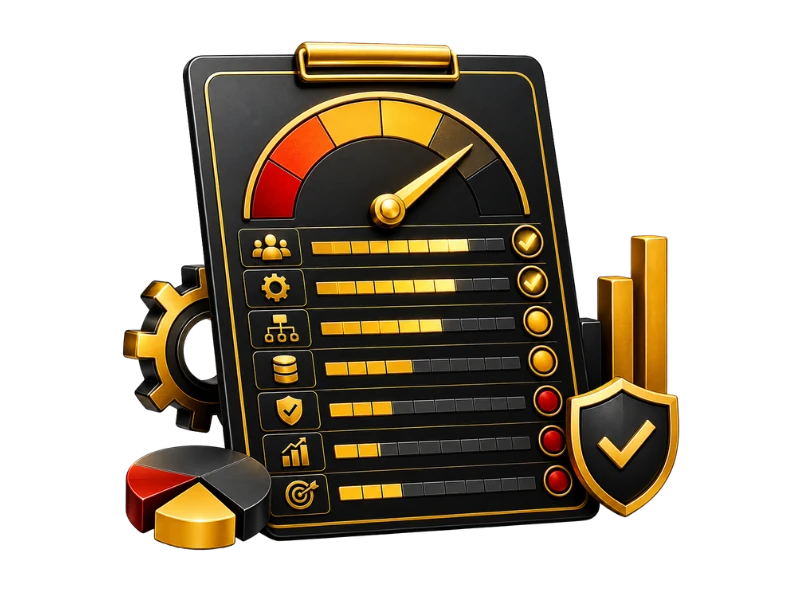
The InsightSolve ERP Implementation Readiness Scorecard assigns a score across all five dimensions, with a maximum of 25 points. Here’s what the score ranges mean in plain terms:
| Score | Readiness Level | What To Do |
| 5-11 | Do not proceed | Launching now means a high probability of failure, cost overrun, or rollback. Foundational gaps – data and process documentation – must be closed first. |
| 12-16 | High risk | Significant scope creep and user rejection risk. A structured 60-day readiness push before go-live will substantially reduce your exposure. |
| 17-21 | Conditionally ready | Strong foundation with 1–2 dimensions needing targeted attention. A final process walkthrough with end users before UAT is strongly recommended. |
| 22-25 | Implementation Ready | Structurally prepared. Protect this readiness by committing to a 30-day hypercare window post-launch to sustain adoption and catch early issues. |
Aim for 80% or higher – that’s 20 out of 25 – before you commit to a Go-Live date. Every point below 20 represents a statistically measurable increase in implementation risk and rework cost.
– Renee Courtney, Principal Consultant, InsightSolve Inc.
Take the free 5-dimension scorecard assessment and get an instant interpretation of where your organization stands – before you commit budget and momentum to an implementation you may not be ready for.
Takes less than 5 minutes. No login required. Get your score instantly.
The Readiness Sprint: How to Close the Gaps Fast
Let’s say you take the scorecard and your score comes back at 14. That’s a high-risk range. What do you actually do with that?
You don’t cancel your ERP project. You run a readiness sprint.
A readiness sprint is a focused, time-boxed effort – typically 45 to 60 days – designed to close your most critical gaps before implementation begins. It’s not glamorous work. It’s the kind of work that rarely makes it into strategy decks. But it is the work that determines whether your ERP investment pays back.
What a Readiness Sprint Covers
| Process Mapping & Stabilization | Document your current-state workflows at the role level. Identify the steps that are inconsistent, undocumented, or dependent on a single person’s knowledge. Stabilize before you digitize. |
| Data Audit & Cleansing | Pull a sample of your master data and run it against your business rules. How many duplicate records exist? How many vendor records have missing fields? How many product SKUs are inactive but still showing as live? Fix these now. |
| SOP Remediation & Development | Build or update your Standard Operating Procedures to reflect the future-state workflows your ERP will support. These become the baseline your implementation partner works from. |
| Change Management Planning | Identify your change champions – the people on your frontline who will influence adoption. Build your communication plan, training approach, and feedback mechanism before go-live, not during. |
| Process Owner Validation | Walk the proposed system design through with the people who actually do the work. Close the gap between what the system does and what your operation needs. |
The Question Leaders Should Be Asking – But Aren’t
Most ERP conversations in the C-suite center on vendor selection, licensing costs, and implementation timelines. Those are important questions. But they are the wrong first questions.
The right first question is: Are we ready for this?
Not “can we afford this?” Not “which vendor has the best features?” But: do we have the process foundation, the data quality, and the organizational capacity to make this investment work?
Asking that question before you sign the contract is free. Discovering the answer after is expensive.
What Readiness-Focused Leaders Do Differently
They assess before they select – using a structured tool, not gut instinct or vendor promises.
They invest in process documentation as a strategic asset, not a compliance checkbox.
They treat change management as part of the implementation budget, not an afterthought.
They define a Go-Live readiness threshold – and refuse to cross it until the score is hit.
They assign a dedicated readiness owner whose job is to close gaps, not manage the vendor relationship.
These behaviors aren’t extraordinary. They’re disciplined. And they are consistently the difference between ERP projects that deliver ROI and ones that become cautionary tales.
Your Next Step Starts With a Score
You don’t need a consultant to tell you whether your organization is ready for an ERP. You need a clear, honest assessment – one that looks at your workflows, your data, your documentation, your change readiness, and your operational alignment, and gives you a scored snapshot of where you actually stand.
That’s exactly what the InsightSolve ERP Implementation Readiness Scorecard is designed to do.
It takes less than five minutes. It covers all five dimensions. And it gives you an actionable interpretation – not just a number – that tells you what to do next, whether that’s proceeding with confidence, running a targeted readiness sprint, or pumping the brakes on a timeline that isn’t ready yet.
Your ERP investment deserves a foundation that’s actually ready to hold it.
What’s Your Biggest ERP Challenge?
I read every comment. Drop your question, experience or your score below – and let’s talk about it. The more specific you are, the more useful I can be.
– Share your readiness score
– Ask a question about your situation
– Tell us where you got stuck
– Share what worked for your team